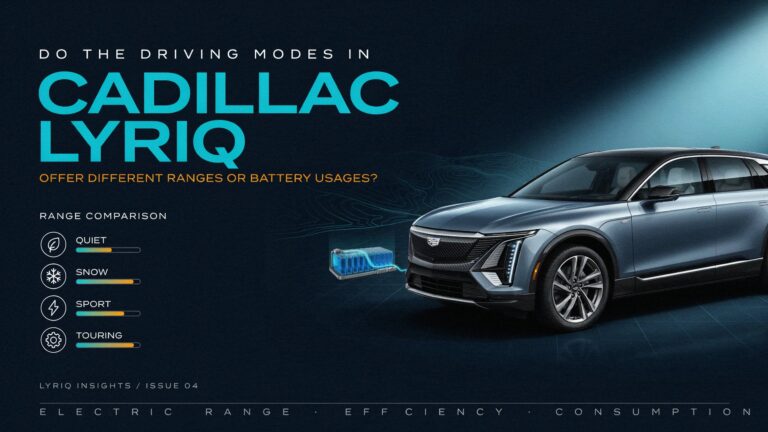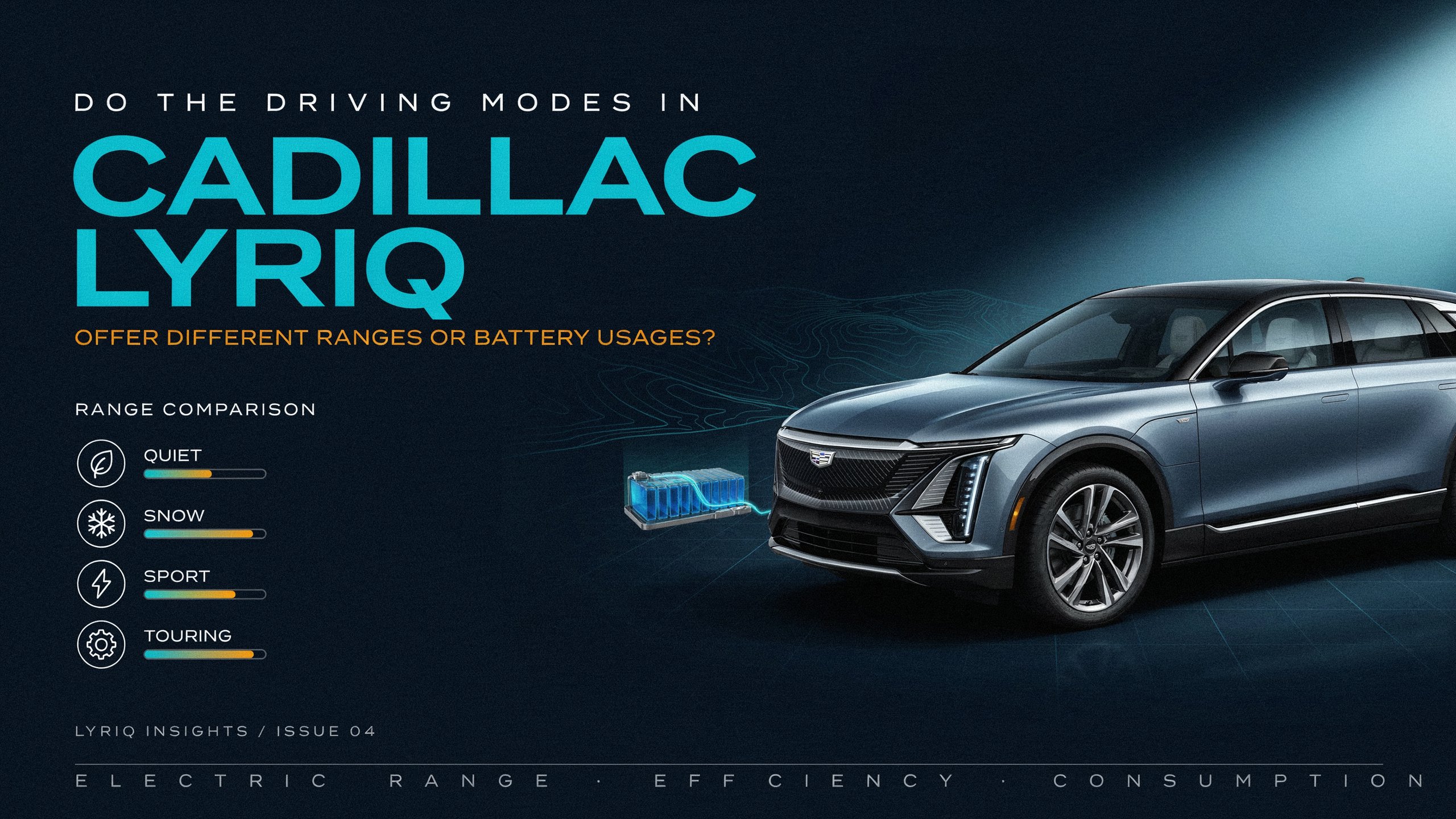
Yes, the driving modes in the Cadillac LYRIQ can influence real-world energy consumption and the range you see between charges, but they do not give the SUV different battery capacities or separate official EPA range ratings. Cadillac describes the modes as changes to vehicle tuning and calibration, including accelerator response, steering, braking feel, suspension and traction behavior, depending on the configuration.
For the current 2026 Cadillac LYRIQ, the headline EPA range is up to 326 miles for single-motor RWD models and up to 319 miles for dual-motor AWD models. The LYRIQ-V is rated at 285 miles, and Cadillac lists a 102 kWh rated battery capacity for the LYRIQ battery platform. Those figures are tied to the vehicle configuration, not to a particular driving mode.
At a Glance: Cadillac LYRIQ Driving Modes
| Attribute | Verified Information |
|---|---|
| Vehicle | Cadillac LYRIQ |
| Current model year covered | 2026 |
| Vehicle type | All-electric luxury SUV |
| Seating | 5 passengers |
| Drivetrain choices | Single-motor RWD or dual-motor AWD |
| Battery platform | GM Ultium |
| Rated battery capacity | 102 kWh |
| Maximum EPA-estimated range | Up to 326 miles with RWD |
| AWD EPA-estimated range | Up to 319 miles with standard 11.5 kW charging |
| LYRIQ-V EPA-estimated range | 285 miles |
| Main driving modes | Tour, Snow/Ice, Sport, My Mode |
| Primary purpose of modes | Change vehicle response and driving characteristics |
| Separate EPA range by mode? | No |
| Battery capacity change by mode? | No |
Cadillac notes that driving-mode availability and the systems affected can vary by trim, region and optional equipment.
What the Driving Modes Actually Change
The key point is that the LYRIQ’s drive modes are vehicle-control settings, not battery-capacity settings. Cadillac’s owner documentation says Driver Mode Control adjusts the overall driving experience by changing multiple systems according to the selected mode.
That distinction explains why two LYRIQ drivers can use different amounts of electricity on the same trip while starting with the same state of charge. A mode that gives the accelerator a sharper response can make stronger acceleration easier, while a traction-oriented mode can change how power is delivered to the road. The resulting energy use depends heavily on what the driver actually does with those settings.
Tour Mode
Tour Mode is the LYRIQ’s normal everyday setting. Cadillac describes it as the predominant mode for regular driving, with tuning and calibration intended to provide a smooth ride and a balanced experience.
For drivers primarily concerned with consistent efficiency, Tour is the obvious baseline. That does not mean Cadillac assigns Tour a special EPA range, however. There is no official Cadillac figure saying that Tour automatically delivers a certain percentage more miles than Sport.
In practice, Tour can support efficient driving because it is designed around smooth, balanced behavior. The actual result still depends on speed, acceleration, road conditions, temperature, climate-control demand, tire condition and other variables.
Sport Mode
Sport Mode is designed for a more immediate and connected driving feel. Cadillac says it provides a more immediate torque response and improved steering at higher speeds, while the owner manual notes changes to items such as pedal tuning, steering effort, suspension tuning and other vehicle characteristics depending on equipment.
Sport Mode therefore can lead to higher energy consumption, particularly when its quicker response encourages harder acceleration. That is an important distinction. Sport itself does not suddenly make the battery less efficient or remove a fixed number of miles from the battery.
A driver can select Sport and still drive gently. In that situation, the difference in consumption may be much smaller than internet claims suggesting a universal 10%, 20% or larger penalty.
There is no authoritative Cadillac source establishing a fixed Sport-versus-Tour percentage reduction in range.
Snow/Ice Mode
Snow/Ice Mode has a different objective. Cadillac says it is intended for snow-covered or slippery roads and changes pedal tuning to optimize traction. On applicable vehicles, it can also modify electric all-wheel-drive behavior and steering.
This mode is therefore about controlled acceleration and traction rather than maximizing range. On dry pavement, Cadillac warns that the mode can compromise acceleration compared with the normal setup.
The bigger range issue during winter driving is often the environment itself. Cold temperatures, winter tires, cabin heating, wet roads and reduced traction can all affect EV efficiency. It would be misleading to attribute every winter range drop to Snow/Ice Mode alone.
My Mode
My Mode is the configurable option. Cadillac says drivers can personalize available vehicle characteristics, with settings that can include acceleration feel, brake feel, steering, suspension and motor sound.
That means My Mode does not have one fixed efficiency profile. A driver can build a calmer configuration or choose settings that emphasize a more responsive experience.
Because of that flexibility, it would be inaccurate to call My Mode inherently efficient or inefficient. Its real-world battery impact depends on the settings selected and, even more importantly, on how the driver uses the accelerator and brakes.
Do Different Driving Modes Change the LYRIQ’s Battery Capacity?
No. Selecting Tour, Sport, Snow/Ice or My Mode does not change the LYRIQ’s battery capacity. Cadillac lists the LYRIQ battery platform at 102 kWh of rated energy capacity, and the company’s published range figures are associated with the vehicle’s powertrain configuration rather than a selectable driving mode.
This is an important distinction because some online explanations blur together battery capacity and energy consumption.
Battery capacity is the amount of stored energy available in the pack. Energy consumption is how quickly the vehicle uses that energy. A driving mode can influence the second factor through vehicle behavior, but it does not transform a 102 kWh battery into a larger or smaller battery.
Does Sport Mode Always Reduce Range?
No. Sport Mode does not come with a guaranteed range penalty. It can increase energy consumption when the driver uses the sharper response to accelerate harder or drive more aggressively, but Cadillac does not publish a fixed percentage reduction in range for Sport Mode.
That means claims online that Sport Mode automatically cuts LYRIQ range by a specific amount should be treated cautiously unless they are backed by controlled testing.
In an EV, driving behavior often matters more than the label attached to the mode. A smooth driver in Sport can potentially consume less energy than an aggressive driver in Tour.
How Regenerative Braking Fits Into the Equation
Regenerative braking is another important part of the LYRIQ’s efficiency story, but it should not be confused with the driving-mode system.
Cadillac describes Regen on Demand as a way to recover some energy from the vehicle’s momentum and store it back in the propulsion battery. The company also notes that regenerative braking can be limited under certain conditions, including when the battery is very full or cold.
Cadillac separately describes regenerative braking as a technology that can help conserve and capture braking energy for additional range.
This matters because smooth use of regeneration can improve energy efficiency, particularly in traffic where the vehicle repeatedly slows down. But regeneration cannot recover all of the energy used to accelerate, and it does not eliminate losses in the electric drivetrain.
What Does the LYRIQ Energy Screen Tell You?
Owners do not need to guess how efficiently their LYRIQ is operating. Cadillac’s Vehicle Status and Energy Info functions provide real-time information about energy use and efficiency.
Depending on the vehicle and software configuration, the Energy Info screen can show:
- Distance driven
- Total energy used
- Average miles per kilowatt-hour
- Recent energy-efficiency performance
- Regenerated miles
- The effect of factors such as climate use and battery-conditioning preparation
Cadillac says the Energy Efficiency view can analyze efficiency over the previous 30 miles, while the Energy Usage display can provide more detail about what is affecting consumption during the current drive.
For comparing modes, these measurements are much more useful than simply watching the estimated remaining range.
What Determines LYRIQ Range More Than the Drive Mode?
Driving mode matters, but it is only one part of the equation. Real-world EV range can vary substantially because of conditions outside the mode selector.
| Factor | Potential Effect on Energy Use |
|---|---|
| Vehicle speed | High speeds generally require more energy |
| Acceleration | Hard acceleration increases power demand |
| Temperature | Extreme cold or heat can reduce efficiency |
| Cabin heating and cooling | Climate systems consume electrical energy |
| Traffic | Frequent acceleration and deceleration can change consumption |
| Terrain | Hills and elevation changes affect energy demand |
| Tires and pressure | Rolling resistance can affect efficiency |
| Wheel and tire configuration | Different setups can influence consumption |
| Payload | More weight generally requires more energy |
| Wind and weather | Headwinds, rain and other conditions can reduce efficiency |
| Battery temperature | Can affect available performance and regenerative braking |
This is why a claimed universal range difference between Tour and Sport should be viewed skeptically. Even two trips in the same mode can produce substantially different efficiency results.
2026 Cadillac LYRIQ Range by Powertrain
Cadillac’s current 2026 specifications provide a useful benchmark for understanding what actually determines the official range rating.
| 2026 LYRIQ Configuration | EPA-Estimated Range |
|---|---|
| Single-motor RWD | 326 miles |
| Dual-motor AWD with standard 11.5 kW charging | 319 miles |
| Dual-motor AWD with available 19.2 kW charging | 303 miles |
| LYRIQ-V dual-motor AWD | 285 miles |
These figures are Cadillac’s published EPA estimates for the respective configurations. They are not separate ratings for Tour, Sport, Snow/Ice or My Mode.
The table also shows why powertrain and hardware configuration matter more fundamentally than drive-mode selection when discussing official range.
How to Test the Difference Between LYRIQ Modes
A practical comparison can be useful, but it needs to be controlled.
For example, a LYRIQ owner could drive the same route repeatedly while keeping as many variables as possible consistent.
| Test Variable | Recommended Approach |
|---|---|
| Starting battery level | Keep it similar for each run |
| Route | Use the same route |
| Speed | Maintain similar speeds |
| Climate control | Use comparable settings |
| Drive mode | Change only the mode being tested |
| Traffic | Test at similar times when possible |
| Weather | Avoid comparing very different conditions |
| Measurement | Record miles/kWh and energy used |
The best metric is usually energy efficiency in miles per kWh, together with the total energy consumed. Cadillac’s own Energy Info system is designed to provide this information.
A single test run should not be treated as proof that one mode is always better. Several comparable trips provide a more reliable picture because wind, traffic, temperature and road conditions can easily distort one result.
Which LYRIQ Driving Mode Is Best for Maximum Range?
Tour Mode is the sensible everyday choice when the goal is a smooth and predictable driving experience, but there is no official Cadillac rule stating that Tour always produces the longest possible range. The biggest efficiency gains usually come from moderate speeds, smooth acceleration, appropriate tire pressure, sensible climate use and effective regenerative braking.
My Mode can also be useful for drivers who want to tailor the vehicle to their habits. A calmer accelerator configuration may support smoother driving, while a sportier setup may encourage higher power demand.
The strongest approach is therefore not simply choosing one mode and assuming it solves range concerns. It is combining a suitable mode with efficient driving habits.
Does Snow/Ice Mode Use More Battery?
Snow/Ice Mode is intended to improve traction on slippery roads, so range should not be the primary reason to choose or avoid it. Cadillac specifically designed the mode around traction and controlled pedal response, with changes to other systems on applicable vehicles.
If conditions are snowy or icy, safe control matters more than chasing a small theoretical efficiency difference. Winter weather itself can have a much larger effect on EV range than the selection of Snow/Ice Mode.
Does Changing Modes Damage the LYRIQ Battery?
There is no indication in Cadillac’s owner documentation that normal selection among the available driving modes is harmful to the LYRIQ battery. These modes are factory-designed operating configurations intended to change the vehicle’s driving characteristics.
The more relevant issue for battery use is not whether the driver selects Tour or Sport, but how much electrical energy the vehicle is drawing and under what conditions. Frequent hard acceleration can increase energy consumption, but that is different from claiming that Sport Mode itself damages the battery.
The Bottom Line on Cadillac LYRIQ Driving Modes and Range
The answer to “Do the Driving Modes in Cadillac LYRIQ Offer Different Ranges or Battery Usages?” is yes for real-world energy consumption, but no for separate official range ratings or battery capacities.
Cadillac’s documentation shows that Tour, Sport, Snow/Ice and My Mode change different aspects of vehicle behavior, including accelerator response and other chassis or control characteristics. Those changes can affect how much electricity a driver uses, especially when a more responsive mode leads to stronger acceleration.
What the modes do not do is change the physical battery capacity or create a dedicated range figure. The 2026 LYRIQ remains rated at up to 326 miles with RWD, while AWD and LYRIQ-V configurations carry their own published ratings based on the vehicle’s hardware and certification testing.
For most drivers, the most reliable way to improve range is simple: choose the mode appropriate for the road, accelerate smoothly, manage climate use, maintain the tires properly and monitor the LYRIQ’s built-in energy-efficiency information rather than relying on assumptions about the mode selector.
Frequently Asked Questions
Do the driving modes in Cadillac LYRIQ offer different ranges or battery usages?
They can produce different real-world energy consumption, but Cadillac does not publish separate EPA range ratings for each drive mode. The battery capacity itself does not change when a mode is selected.
Which LYRIQ mode is best for range?
Tour is the natural everyday baseline because Cadillac designed it for smooth, balanced driving. However, driving habits and conditions often have a greater effect on efficiency than the mode name itself.
Does Sport Mode reduce LYRIQ range?
It can reduce real-world efficiency when its more immediate response results in harder acceleration, but there is no fixed Cadillac-published percentage penalty for Sport Mode.
Does Snow/Ice Mode change battery capacity?
No. Snow/Ice Mode changes vehicle behavior to improve traction on slippery surfaces. It does not change the LYRIQ’s battery capacity.
How can LYRIQ owners measure energy usage?
Cadillac’s Vehicle Status or Vehicle Information system can show Energy Usage and Energy Efficiency information, including total energy used, miles per kWh and regenerated miles, depending on vehicle configuration.
Also Read: CnLawBlog Explained | Origins, Content, and Credibility
About the Author